NEP 2020 asks schools to move beyond the marks-only report card to a holistic progress card: a record of how each child is growing in thinking, social and emotional skills, physical development and creativity, not only subject scores. NCERT's PARAKH centre has published HPC templates for each stage of schooling, and many schools are now working out how to use them without burying teachers in paperwork.
This guide explains what the HPC is, how it differs by stage, what goes into it, and how to roll it out in a practical way.
What is the Holistic Progress Card?
The Holistic Progress Card (HPC) is a multidimensional report of a child's progress. NEP 2020 calls for a 360-degree report that reflects progress across cognitive, socio-emotional and physical development, and the uniqueness of each learner.
Rather than a single marks sheet issued at the end of term, the HPC brings together:
- Teacher assessment through observations, projects, activities and tests.
- Self-assessment by the child, describing what they learned and what they found hard.
- Peer assessment, where classmates reflect on group work.
- Parent feedback on the child's interests and progress at home.
The aim is a fuller picture that parents and teachers can act on, and a record that follows the child from year to year.
The four stages of the holistic progress card
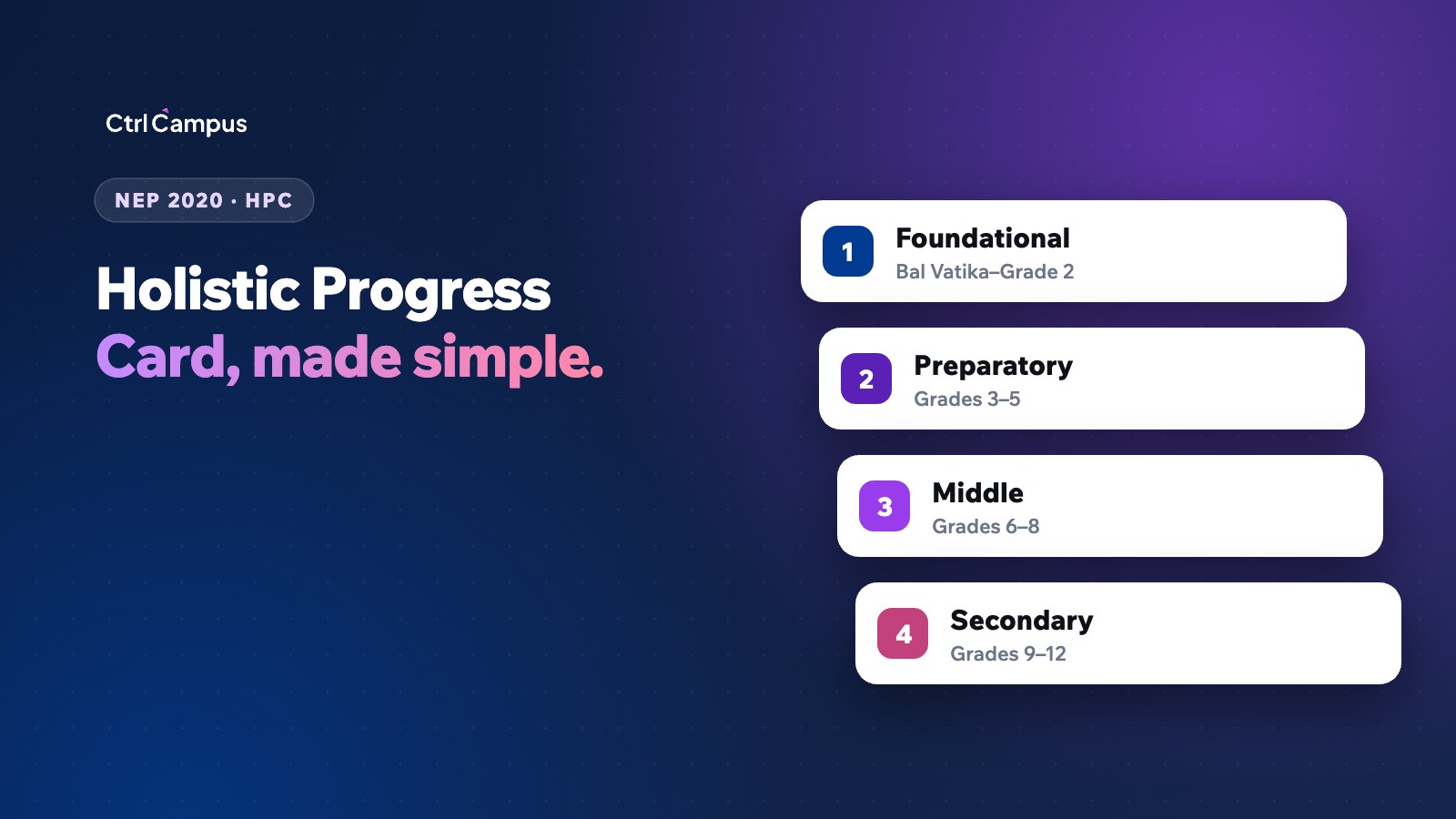
PARAKH's templates follow the 5+3+3+4 structure of NEP 2020.
Foundational stage (Bal Vatika to Grade 2)
Mostly activity- and play-based. Teachers record observations against learning goals such as language, early numeracy, motor skills and social interaction. Children's self-assessment uses simple pictures and symbols.
Preparatory stage (Grades 3 to 5)
Adds more structured self and peer reflection alongside teacher observation, with a focus on reading, writing, numeracy and curiosity.
Middle stage (Grades 6 to 8)
Subjects become more distinct. The HPC records competencies in each subject, project work, and the child's own goals and reflections.
Secondary stage (Grades 9 to 12)
Covers subject competencies, co-scholastic areas and the student's aspirations and career interests, alongside preparation for board examinations.
Holistic progress card vs a traditional report card
- Traditional report card: marks or grades per subject, mostly from written exams, issued at the end of term.
- HPC: competencies and learning outcomes, evidence from many kinds of assessment, the child's own voice and parent input, built up through the year.
The HPC does not remove marks or exams. Summative assessments still count; they become one part of a broader record. For parents, the biggest change is that the card explains what their child can do and where they need help, instead of only how they ranked.
What a good HPC entry looks like
Instead of "Maths: 78 out of 100", a middle-stage entry might note that the child solves two-step word problems independently, needs support with fractions, enjoyed a measurement project and has set a goal to practise mental arithmetic. The marks are still there, but the parent now knows what to work on at home, and next year's teacher knows where to start.
The real challenge: teacher workload
The idea is easy to agree with. The difficulty is the paperwork. A class teacher with 40 children, several subjects and multiple domains per subject can't fill long paper templates by hand every term. Schools that roll out the HPC successfully usually:
- Start with one stage. Pilot the foundational or preparatory stage first.
- Define a short list of competencies per subject. Use the PARAKH templates as the base and keep descriptors simple.
- Record evidence through the term. Enter observations and project grades as they happen, not at the end.
- Use rubrics. A shared rubric makes grades consistent between teachers and sections.
- Collect self, peer and parent inputs digitally. Short forms are easier to complete and collate than paper sheets.
- Generate the card from the data. The HPC should be produced from what teachers already entered, not typed again.
- Train teachers and explain it to parents. Parents used to marks need to understand what the new card shows and how to use it.
Common questions from teachers
Teachers often ask whether the HPC means more testing. It shouldn't. Most of the evidence already exists in class activities, projects and observations; the change is recording it consistently. Teachers also ask how to stay objective. Clear rubrics, shared examples of each level and moderation between sections help grades mean the same thing across the school.
Involving parents
Parents are part of the HPC, not only readers of it. A short form each term asking what the child enjoys, what they find hard at home and what the parent would like the school to focus on is usually enough. Share the completed card in the parent app and invite questions at the next parent-teacher meeting.
How CtrlAssess supports NEP 2020 assessment
CtrlAssess is CtrlCampus's assessment app, built for NEP 2020. Teachers plan formative and summative assessments, such as quizzes, projects, observations and exams, with weightage per term. Co-scholastic grades, rubrics, and self and peer assessments sit in one place, and each child's growth on every competency is tracked across terms and years.
Marks are entered once from CtrlOne, the staff app, and flow into report cards in the ERP and to parents in CtrlGo, with no re-entry. Board-ready reports are available for CBSE, ICSE and state boards.
Because assessments sit on the same student record as attendance and fees, there is no separate app for teachers to learn. Read why one platform beats a stack of tools in School ERP vs 7 separate apps, or see how Oaktree Kidz runs on CtrlCampus.
FAQ: holistic progress card
Is the holistic progress card mandatory?
NEP 2020 recommends it, and NCERT's PARAKH has released templates. Whether and when it is required depends on your board and state, so follow their latest circulars.
Does the HPC replace exams and marks?
No. Summative assessments and marks remain. The HPC adds other evidence and the child's own reflection around them.
Who fills in the HPC?
Teachers record most of it, with inputs from the child through self-assessment, from classmates through peer assessment, and from parents.
How often should it be updated?
Evidence should be recorded through the term, with the card shared with parents at the end of each term.
Can the HPC be generated digitally?
Yes. When assessments, rubrics and reflections are entered in software, the card can be generated from that data. Book a demo to see CtrlAssess with your own subjects.