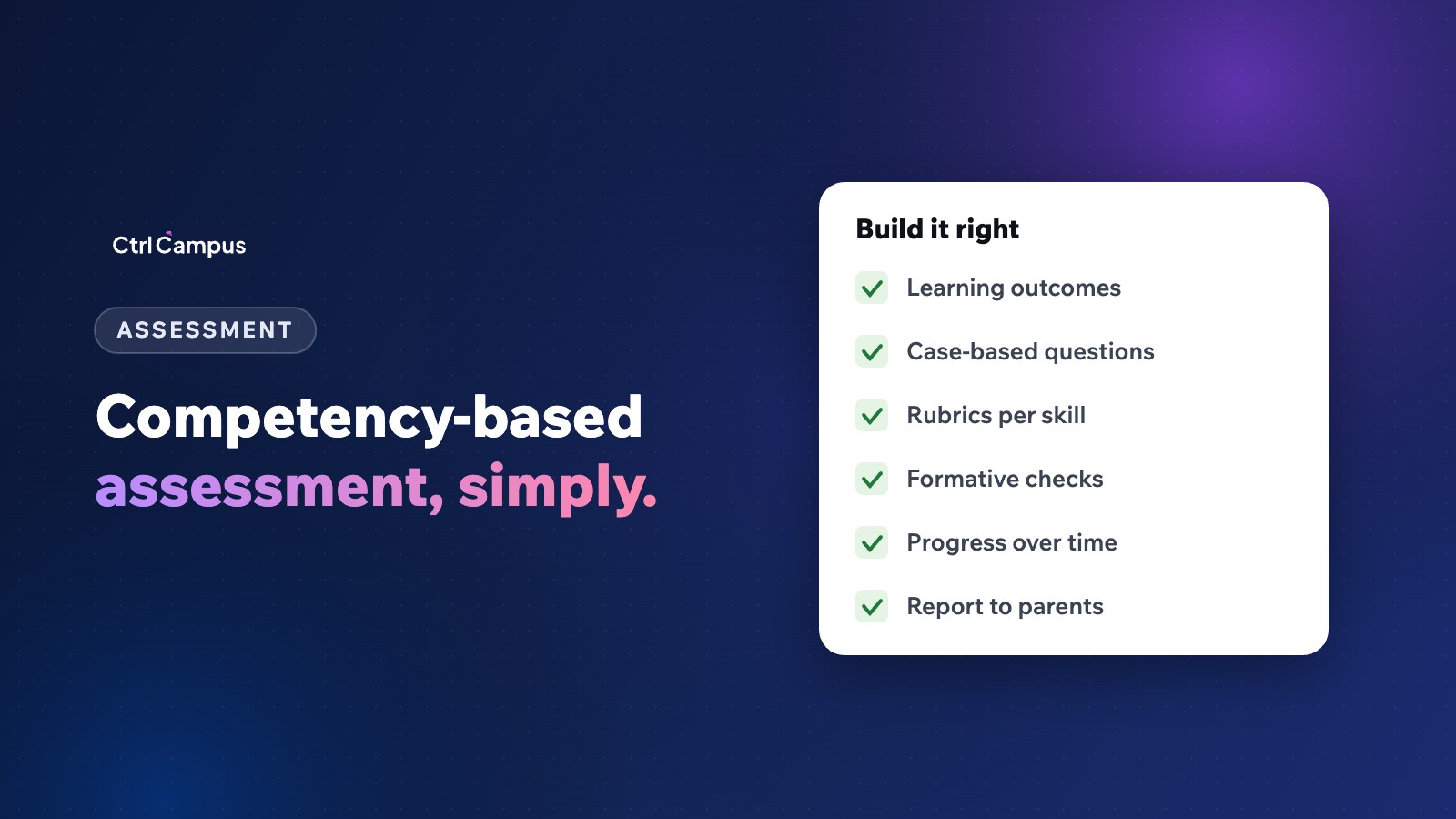
Quick answer: competency-based assessment checks whether students can apply what they learned to new situations, not just recall it. In practice it uses case-based and source-based questions, real-life problems, projects and observation, marked with clear rubrics, with progress on each competency tracked across the year.
Last updated: November 2026.
NEP 2020 asks schools to shift from rote learning to competency-based learning, and CBSE has steadily increased the share of competency-focused questions in its board papers. Check the current year's CBSE sample papers for the exact pattern in each subject. For teachers, the question is practical: what does a competency-based question look like, and how do we mark it fairly?
What competency-based assessment means
A competency is the ability to use knowledge and skills in context. Instead of asking "What is photosynthesis?", a competency-based question might give students data from an experiment and ask them to explain what it shows. The learning outcome is the same; the evidence is stronger.
Question types that test competencies
Case-based questions
A short passage, situation or data set, followed by questions that require analysis.
Source-based questions
A map, graph, table, image or extract, with questions about what it shows and why.
Assertion and reason
Students judge whether a statement and its reason are true, and whether the reason explains the statement.
Real-life problems
Maths and science problems set in everyday contexts, such as shopping, travel or measurement.
Open-ended tasks
Short projects, presentations or experiments, assessed with rubrics.
Writing rubrics
A rubric lists the criteria for a task and describes what each level looks like. For example, a science explanation might be assessed on accuracy of concepts, use of evidence, and clarity, each at three or four levels. Good rubrics:
- Describe observable work, not vague qualities.
- Use the same levels across classes and teachers.
- Are shared with students before the task.
- Come with examples of work at each level.
Formative and summative together
Competencies grow over time, so a single exam is not enough. Use short formative checks, such as exit questions, quizzes and observations, through the term, and summative assessments at the end. Record both against the same competencies.
Tracking progress on each competency
When every assessment is mapped to learning outcomes, the school can see each child's progress on each competency across terms and years. That is what makes the Holistic Progress Card meaningful rather than a form to fill.
Getting teachers started
- Pick one subject and class to pilot.
- Map the term's lessons to learning outcomes.
- Convert a few existing questions into case-based ones.
- Agree on rubrics and moderate a sample together.
- Record results against outcomes, not just totals.
How CtrlAssess helps
CtrlAssess is built for NEP 2020: competency-based outcomes, formative and summative assessments with weightage per term, co-scholastic grades, rubrics, and self and peer assessments in one place. Each child's growth on every competency is tracked across terms and years, and report cards are generated from the same data. See our guide to the CBSE report card format and the Oaktree Kidz case study.
FAQ: competency-based assessment
What is competency-based assessment?
Assessment that checks whether students can apply knowledge and skills in new situations, using tasks such as case-based questions and projects.
Does it replace exams?
No. It changes the kind of questions and adds formative evidence, alongside summative exams.
How do we mark open-ended answers fairly?
With shared rubrics, examples of each level and moderation between teachers.
How many competency-based questions does CBSE use?
The share varies by class and subject and has been increasing. Check the current year's CBSE sample papers.
Can software track competencies?
Yes, when assessments are mapped to learning outcomes. Book a demo to see CtrlAssess.