School payroll looks simple until the end of the month. Pay scales differ by role and seniority, staff take different kinds of leave, some join mid-month, and every salary has to carry the right PF, ESI and professional tax deductions. Many schools manage this in a spreadsheet maintained by one person, which works until that person is on leave or a rule changes. School payroll software takes the arithmetic out of the month-end rush and keeps statutory deductions right.
This guide covers the deductions every Indian school deals with, how salaries are structured, and what to look for in payroll software. It is general information, not tax or legal advice, so confirm specifics with your chartered accountant.
What goes into a school salary
A typical monthly salary for teaching and non-teaching staff includes:
- Basic pay and dearness allowance (DA), often based on a pay scale or grade.
- Allowances such as house rent, transport or special allowances.
- Variable items such as extra periods, exam duty or bus duty.
- Deductions for PF, ESI, professional tax, income tax (TDS), loans or advances, and loss of pay for unpaid leave.
The result is a payslip for each employee and a set of statutory payments the school must deposit every month.
Provident Fund (PF) for schools
Establishments with 20 or more employees are generally covered by the EPF scheme. The core rules:
- The employee contributes 12% of basic pay plus DA.
- The employer also contributes 12%, split into 3.67% to EPF and 8.33% to the Employees' Pension Scheme (EPS).
- Contributions are mandatory on wages up to ₹15,000 a month. At that ceiling, the employee's share is ₹1,800 a month.
- The EPS share is calculated on wages up to ₹15,000, so it is at most ₹1,250 a month, and the rest of the employer's share goes to EPF.
- Contributions on wages above ₹15,000 are voluntary and need a joint option by the employer and the employee.
PF is deposited monthly, with an electronic challan-cum-return filed on the EPFO portal.
ESI for schools
The Employees' State Insurance scheme covers employees earning up to ₹21,000 a month (₹25,000 for persons with disabilities) in establishments and areas where ESI applies. Many states have extended ESI coverage to private educational institutions, so check whether your school is covered.
- Employee contribution: 0.75% of gross wages.
- Employer contribution: 3.25% of gross wages.
Covered employees and their families get medical care and cash benefits through ESIC. Like PF, contributions are paid monthly, and staff who cross the wage limit mid-year need careful handling.
Professional tax (PT)
Professional tax is levied by state governments, so the slabs and due dates depend on where each branch is. Several states, including Karnataka, Telangana, Andhra Pradesh and Maharashtra, levy it, and some states don't levy it at all. The Constitution caps professional tax at ₹2,500 per person per year.
For school groups with branches in more than one state, payroll has to apply each state's slabs to the staff working there. This is where spreadsheets most often go wrong.
The labour codes and your salary structure
India's four labour codes came into force in November 2025. Among other changes, the Code on Wages defines wages so that if allowances exceed half of total remuneration, the excess is treated as wages. That can raise PF and gratuity costs for salary structures with a small basic, so review your structures with your chartered accountant.
Common school payroll mistakes
- Calculating PF on gross pay instead of basic plus DA.
- Forgetting the ₹15,000 ceiling on the EPS share.
- Missing new joiners who are covered by ESI, or staff whose pay has crossed the limit.
- Applying one state's PT slab to staff in another state's branch.
- Paying full salary for unapproved absences because attendance and payroll don't talk to each other.
- No record of salary revisions, leaving arrears to be calculated by hand.
- Payslips sent late or on paper, which leads to queries at the accounts office every month.
What to look for in school payroll software
- Pay scales and grades for teaching and non-teaching staff.
- Automatic PF, ESI and PT calculations, with state-wise PT slabs.
- Attendance and leave feeding payroll directly, so loss of pay is calculated automatically.
- Payslips staff can see on their phones.
- Statutory reports ready for filing.
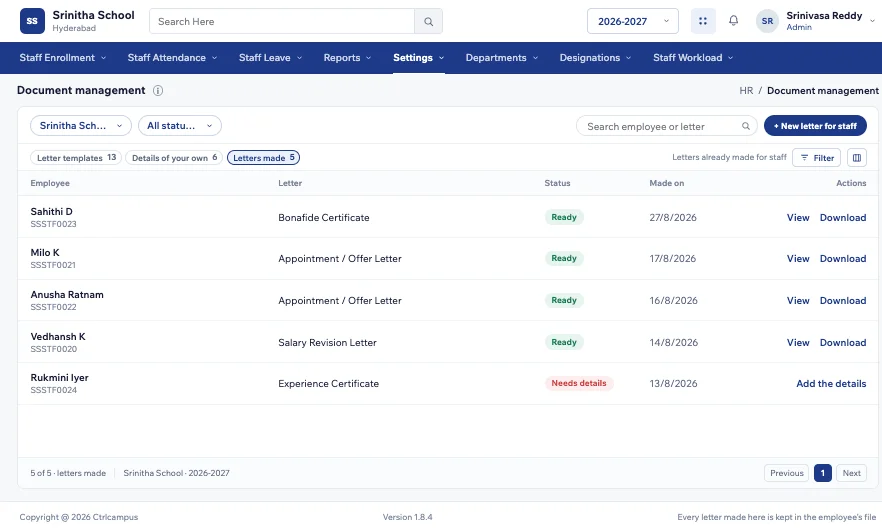
- Staff documents, such as appointment letters and certificates, stored with the employee record.
- Multi-branch payroll with a consolidated view for management.
A month-end payroll routine
- Lock attendance and leave for the month once approvals are done.
- Review joiners, leavers and revisions so arrears and part-month pay are right.
- Run payroll and check totals against last month for unusual changes.
- Approve and publish payslips to staff.
- Deposit PF, ESI and PT and file the returns before their due dates.
- Keep the reports for audits and inspections.
How payroll works in CtrlCampus
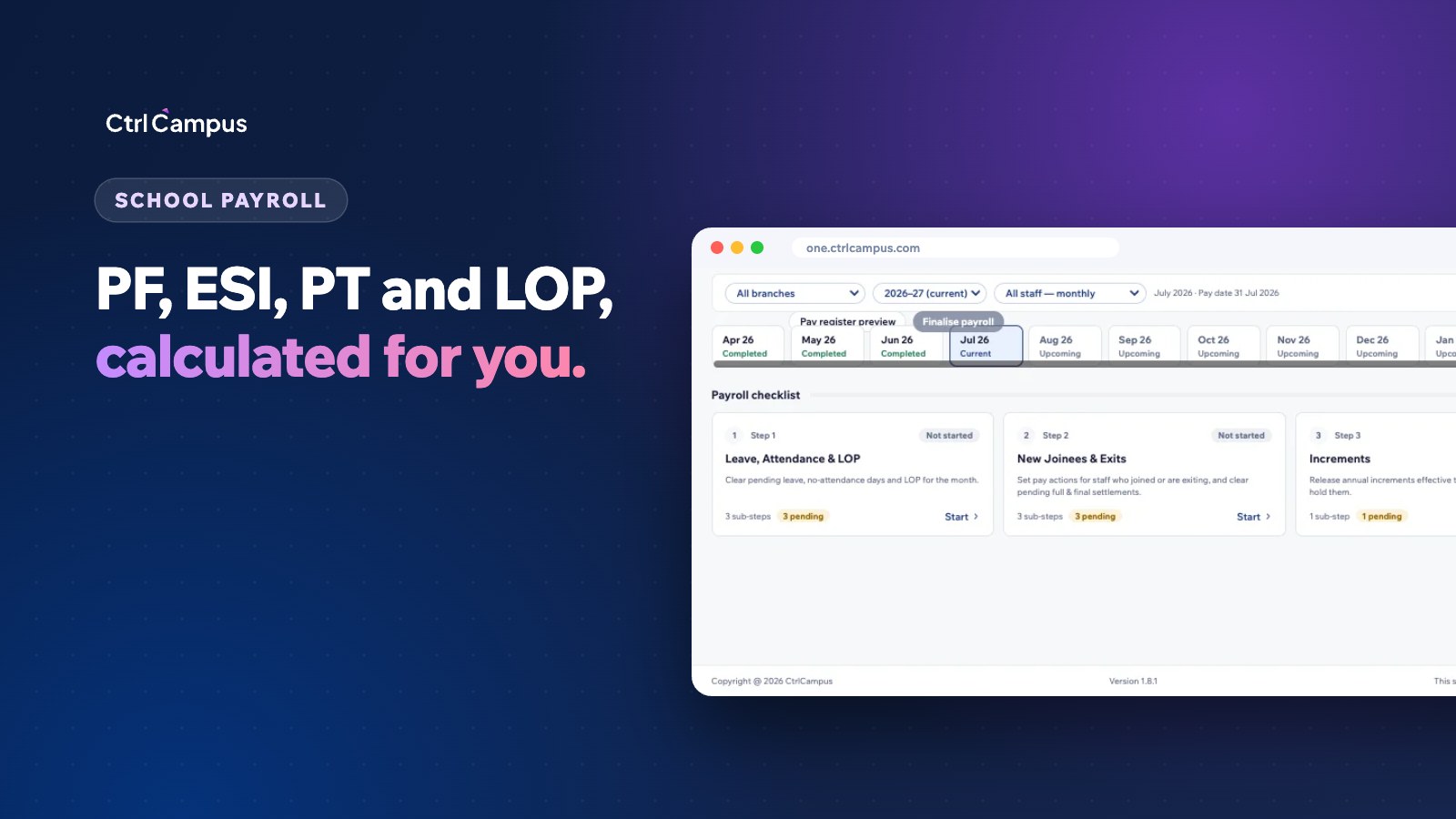
CtrlCampus HRMS keeps every staff record, approves leave and runs monthly payroll with pay scales, PF, ESI and PT, in the same system the school already uses. Staff attendance from CtrlLens face recognition feeds payroll directly, so there is no export from a biometric machine. Staff check in, apply for leave and see their payslips in the CtrlOne app, and holiday calendars and staff documents sit in one place.
For management, the live staff register covers every branch, with leave approvals and department views. To compare total costs with your current tools, see our school management software cost guide and the Oaktree Kidz case study.
FAQ: school payroll software
Do private schools have to pay PF?
Establishments with 20 or more employees are generally covered by the EPF Act, and smaller ones can register voluntarily. Confirm your school's status with your CA.
What is the mandatory PF contribution per month?
On the ₹15,000 wage ceiling, the employee's 12% share is ₹1,800 a month, matched by the employer. Contributions on higher wages are voluntary.
Are teachers covered by ESI?
Staff earning up to ₹21,000 a month are covered where ESI applies to your school. Many states have extended ESI to private educational institutions.
How much is professional tax?
It depends on the state and salary slab, with a constitutional cap of ₹2,500 per person per year.
Can staff see their payslips on their phone?
In CtrlCampus, staff see payslips in the CtrlOne app. Book a demo to see payroll running on your own pay scales.