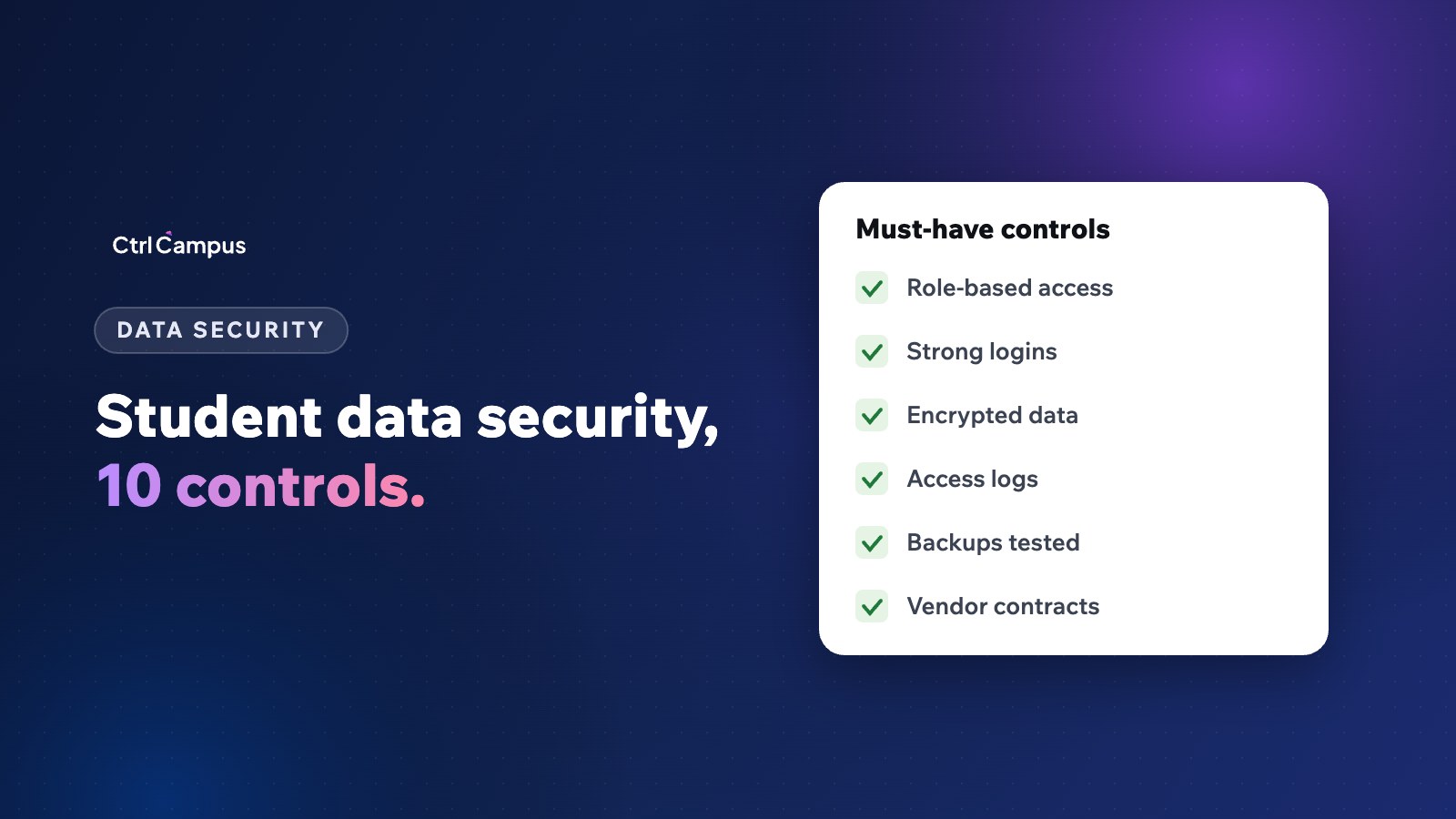
Quick answer: student data security comes down to ten controls: know what data you hold, give access by role, use strong logins, encrypt data, keep logs, back up and test restores, check your vendors, limit sharing on personal phones, plan for breaches and train staff. Under India's DPDP Act, the school stays responsible even when a vendor holds the data.
Last updated: November 2026.
Schools hold some of the most sensitive data of any organisation: children's names, photos, addresses, health notes, marks, fee records and parents' phone numbers. Much of it sits in spreadsheets, staff phones and several vendors' systems. These ten controls bring it under control.
10 student data security controls
1. Know what you hold
List the personal data you collect about students, parents and staff, where it is stored, and why. You can't protect what you don't know about.
2. Access by role
Each person sees only what their job needs. A class teacher doesn't need fee details for the whole school; a counsellor doesn't need payroll.
3. Strong logins
Individual accounts for every staff member, strong passwords, and two-step verification for administrators. No shared logins.
4. Encryption
Data should be encrypted in transit and at rest, especially in cloud systems and backups.
5. Logs
Record who accessed or changed sensitive data and when, so problems can be traced.
6. Backups and restore tests
Back up regularly and test that you can restore. A backup that has never been tested is a hope, not a plan.
7. Vendor checks
Every vendor that holds your data, from the ERP to the payment gateway, should have security certifications, contracts covering breaches and deletion, and clear access controls.
8. Less data on personal phones
Parents' numbers in staff phones and class WhatsApp groups are hard to control. Official channels from the school's verified number reduce this.
9. A breach plan
Decide in advance who does what if data is lost or exposed, how parents are told, and how the authorities are informed when required.
10. Staff training
Most incidents start with a person: a shared password, a lost phone, an email to the wrong address. Short, regular training helps.
Questions to ask your software vendors
- Which certifications do you hold, such as ISO 27001?
- Where is our data stored, and who in your company can access it?
- How quickly will you tell us about a breach?
- Can we export our data, and will you delete it if we leave?
- Which other companies process our data on your behalf?
Student data security and the DPDP Act
Under the DPDP Act and Rules, schools are data fiduciaries responsible for reasonable security safeguards, breach reporting and their processors. Most duties apply from 13 May 2027. Our DPDP Act guide for schools explains the timeline.
Fewer vendors, less risk
Every extra app is another place student data lives. Running admissions, fees, attendance, transport, HR and parent communication on one platform reduces the number of companies holding your data. Read School ERP vs 7 separate apps.
How CtrlCampus protects school data
CtrlCampus is ISO 27001 certified with a 99.9% uptime SLA and is aligning with the DPDP Act, 2023. Because one platform replaces several apps, fewer companies hold your students' data. Messages go from your school's verified WhatsApp number, and if a school leaves, we delete its data and confirm it in writing. See our security page, cloud vs on-premise school ERP and the Oaktree Kidz case study.
FAQ: student data security
What is student data security?
Protecting students' personal data from loss, misuse and unauthorised access, through access control, encryption, backups, vendor checks and training.
Who is responsible if a vendor has a breach?
Under the DPDP Act, the school as data fiduciary remains responsible, which is why vendor contracts matter.
Are WhatsApp groups safe for school communication?
They spread parents' numbers widely. An official school number with templates is safer.
How often should backups be tested?
At least each term, and after any major change.
Do small schools need these controls?
Yes. Small schools hold the same kinds of data and face the same risks. Book a demo to see role-based access in CtrlCampus.