Parents in India read WhatsApp far more reliably than email or SMS, which is why so many schools now send fee reminders, attendance alerts and circulars there. But there is a big difference between a teacher forwarding messages from a personal phone and a school using the WhatsApp Business API for schools, with a verified number, approved templates and every message logged.
This guide explains the three ways schools use WhatsApp, how the official API works, how Meta charges for it, and what to check before you sign up with a provider.
Three ways schools use WhatsApp today
1. Personal numbers and class groups
Teachers and office staff message parents from their own phones, or run class groups. It is free and familiar, but parents' numbers end up on staff phones, there is no record of what was sent, and groups get noisy. When a teacher leaves, the conversations leave with them.
2. The WhatsApp Business app
The free Business app gives the school a profile, labels and quick replies on one phone or a few linked devices. It can work for a small pre-school, but it can't send automated messages from your ERP, and messaging hundreds of parents at once is limited.
3. The WhatsApp Business Platform (API)
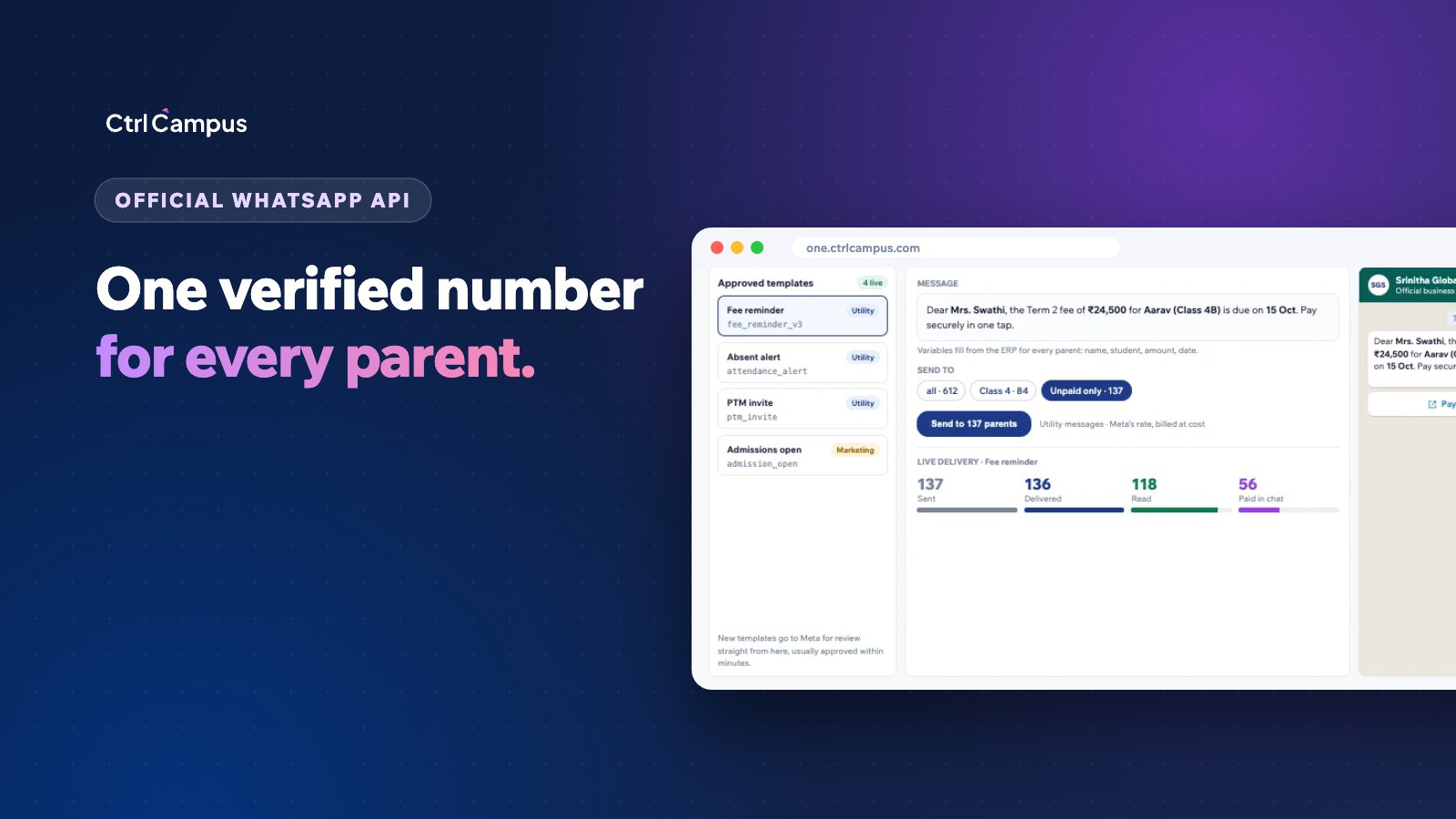
The API connects your school's number directly to your software. Fee reminders, receipts, attendance alerts and admission replies go out automatically from one verified number, and every message is logged. This is the option built for schools with hundreds or thousands of parents.
How the WhatsApp Business API for schools works
A few terms are worth knowing before you talk to any provider:
- Business verification. Meta verifies your institution through its business tools, using your registration documents.
- Display name and number. The school's name appears on messages from a dedicated number. A number on the API can't be used in the regular WhatsApp app at the same time.
- Message templates. Any message the school starts, such as a fee reminder or a circular, must use a template approved by Meta. Templates have placeholders for the student's name, amount and due date.
- Template categories. Meta groups templates into marketing, utility and authentication. Fee reminders and attendance alerts are usually utility, while admission campaigns are marketing.
- The customer service window. When a parent messages the school, a 24-hour window opens in which the school can reply freely.
- Opt-in. Parents must agree to receive messages from the school on WhatsApp. Collect this at admission or in the parent app.
What does WhatsApp cost a school?
Meta charges businesses for the template messages it delivers, at rates that depend on the template category and the recipient's country. Replies to parents inside the 24-hour customer service window are not charged. Meta publishes its current rates for India on its developer site and updates them from time to time, so always check the latest rate card.
The bigger difference usually comes from the provider. Many resellers add their own markup on each message or sell credits in bundles. Ask any provider whether you pay Meta's rates at cost or a marked-up rate, and how the billing works.
When you compare options, also count the cost of not using the API: staff time spent forwarding messages one by one, reminders missed when a phone is switched off, and parents' numbers sitting on personal phones.
What is a Meta Tech Provider?
A Tech Provider is a software company approved by Meta to connect businesses to the WhatsApp Business Platform directly through its own product. For a school, it means the WhatsApp number is set up inside the software you already use, with no middleman between your school and Meta.
CtrlCampus is a Meta Tech Provider. Your school's verified number runs on Meta's WhatsApp Cloud API, and messages are sent from inside CtrlCampus.
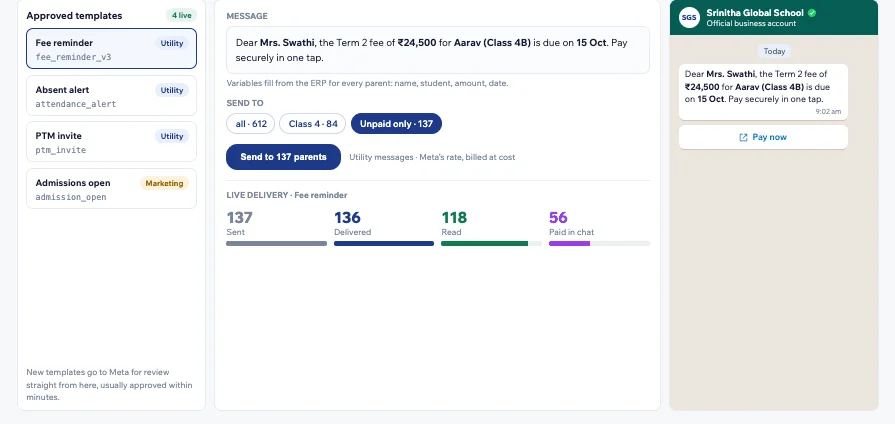
What schools should send on WhatsApp
- Fee reminders and receipts. A reminder before the due date and a receipt the moment payment lands. See our guide to reducing school fee defaults.
- Attendance alerts. Parents of absent children told the same morning. With face recognition attendance, this happens automatically.
- Bus alerts. Delays and arrival notices from the transport office.
- Circulars and events. Holidays, PTMs and exam schedules.
- Admission replies. Instant answers to enquiries, tracked in the admission CRM.
Mistakes schools make on WhatsApp
- Sending promotional messages to every parent, every day. Parents can block or report the number, which hurts its quality rating.
- Using a personal phone number for official communication.
- Templates with vague wording. Clear, specific templates are approved faster.
- No record of opt-in. Keep proof that each parent agreed to receive messages.
- Messaging from several numbers. One verified school number builds trust.
A simple message calendar for the term
Parents respond better when messages are predictable. A typical term might look like this:
- Start of term. Welcome note, timetable, fee schedule and bus routes.
- A week before each fee due date. A reminder with the amount and a payment link.
- Every school day. Absence alerts only for children marked absent.
- Before each PTM or exam. The schedule and what to bring.
- End of term. Report card availability and holiday dates.
Everything else can wait for the parent app, so WhatsApp stays useful rather than noisy.
How official WhatsApp works in CtrlCampus
With CtrlCampus official WhatsApp, fee reminders, receipts and attendance alerts go out from your school's verified number automatically. Templates are approved inside the app, you pay Meta's rates at cost, and parents can pay inside the chat. Admission enquiries are answered automatically and land in the CRM, and every CtrlCampus product, from the ERP to CtrlBus, messages parents through this one channel.
Oaktree Kidz moved parent communication, admissions, fees and attendance onto CtrlCampus and reported an 80% reduction in operational cost.
FAQ: WhatsApp Business API for schools
Can we keep our school's existing number?
Often yes, but a number on the API cannot be used in the regular WhatsApp or WhatsApp Business app at the same time. Many schools use a dedicated number for the API so the office phone stays as it is.
Do parents need to install anything?
No. Parents receive messages in their normal WhatsApp app.
How long does setup take?
It depends mainly on Meta's business verification and template approvals. Having your registration documents ready speeds it up.
Can we send messages in Telugu, Hindi or other languages?
Yes. Templates can be created in many languages, including Indian languages, and each is approved separately.
How should schools handle parents' data on WhatsApp?
Send only what parents need, collect consent, and keep the message log in your own system. Our DPDP Act guide for schools covers the wider rules. Book a demo to see broadcasts and fee reminders from a verified school number.